User Experience
10.2020
How Design Thinking and Design Sprints enhance the innovation process for our clients
Your Contact

Yijun
User Experience
User Experience
We specialize in solving problems where human experience meets technology. Discover how we transform your ideas into tangible solutions – from the very first concept through continuous optimization.
Design Thinking & Design Sprints
Often used merely as a buzzword, Design Thinking has long evolved into a full-fledged organizational philosophy. It enables teams to create the right products or services for the right user groups – always keeping users at the center of every step, method, and action.
How do we approach this? As one of many methods within the Design Thinking process, Allround Team conducts Design Sprints with clients from a wide range of industries – on‑site or fully remote. Originally developed by Jake Knapp at Google Ventures, the methodology pursues an ambitious goal: to evaluate the potential success of a product early on — without lengthy and costly development cycles.
When developing the method, Knapp set out to find an efficient way to shorten product development cycles, generate user feedback quickly, and give decision‑makers the ability to assess the potential success of a product or service early on. The result was a working concept that was first applied within Google Ventures – and soon adopted by leading companies around the world as a powerful tool in their innovation processes. True to the spirit of “Design Doing,” the sprint process continues to evolve and adapt over time.
A traditional Design Sprint is a workshop format in which an interdisciplinary team from across an organization tackles a challenge together over the course of five intensive days. The outcome is not merely a conceptual direction for a potential product – it is a tested first prototype that generates valuable user feedback.
The prototypes created during a Design Sprint are not intended to function as MVPs showcasing the full feature set. Instead, they serve a directional purpose: giving users a quick, tangible impression of the potential product and enabling meaningful insights. After two days of workshop activities and subsequent prototyping, the sprint culminates in a day of user testing, during which the concept is validated and concrete next steps for product development can be derived.
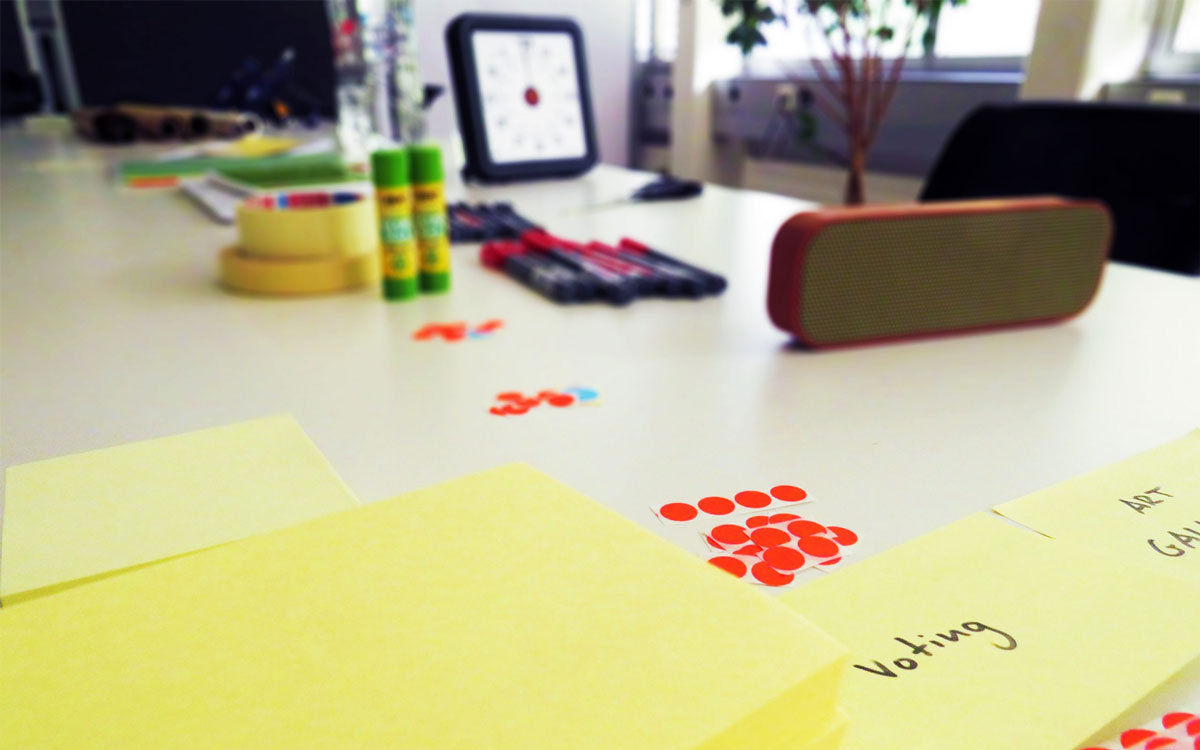
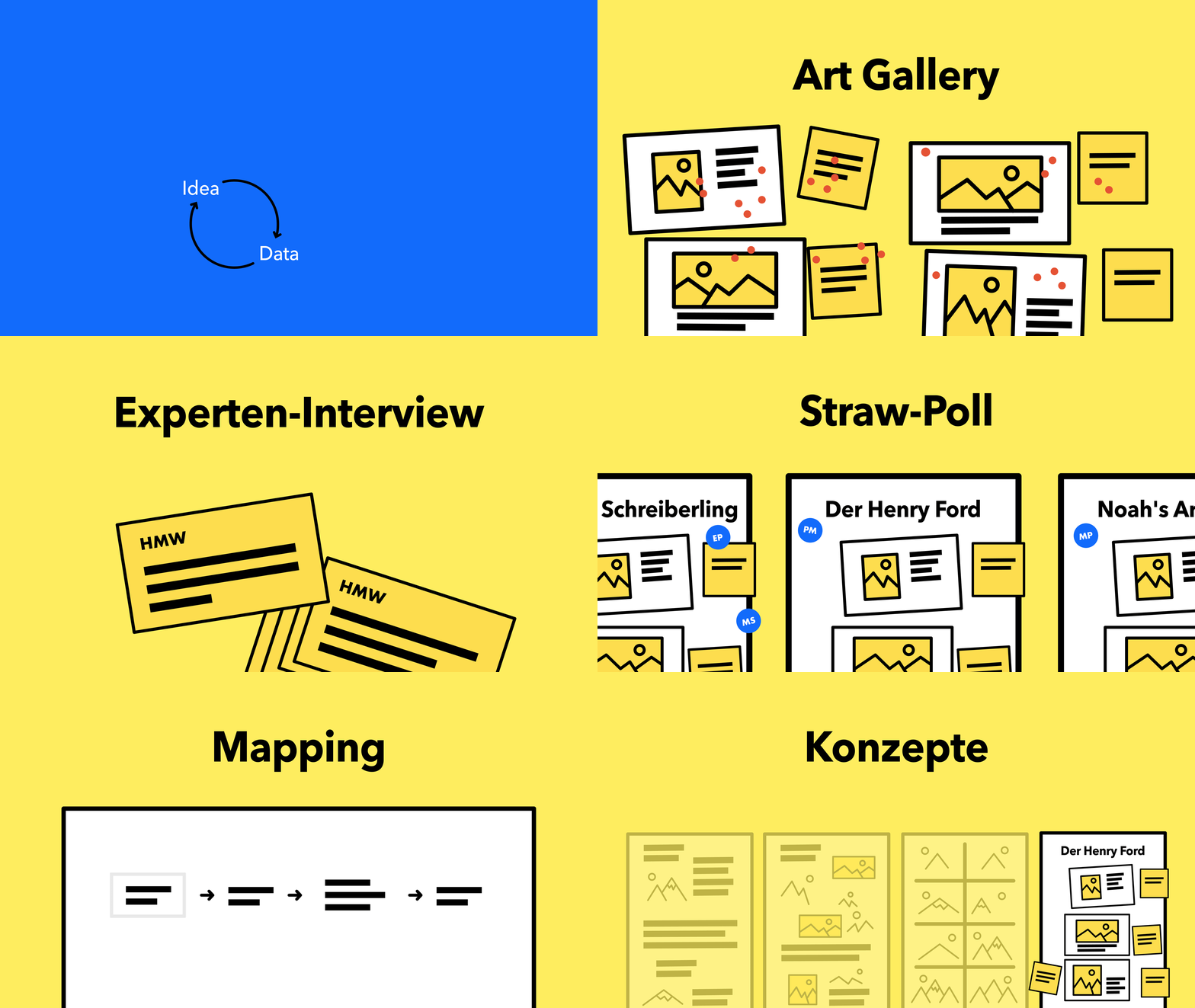
The Design Sprint relies on working principles specifically crafted for high‑intensity innovation processes – sprints in the truest sense of the word. The entire process is divided into short time windows; each step has a strict time limit, reinforced by a timer in the room (or, in COVID‑19 times, the virtual workspace). To avoid the classic pitfalls of traditional meetings – the “enemy” of innovation – endless discussions are replaced by the “together‑alone” principle: everyone works simultaneously, but individually, on the same task. All results are made visible in the room as physical artifacts, ensuring that nothing remains abstract or open to interpretation (principle: “Tangible Beats Discussion”). Decision‑making is simplified, structured, and visualized through the “Note‑Stick‑Vote” method.
As a process designed to move from problem definition to real user feedback in the shortest possible time, the Design Sprint enables us to guide our clients step by step toward successful product development – structured, focused, and insight‑driven.
Inspiring and activating
Dive deeper: These posts from the same category offer new perspectives, inspiring impulses, and further ideas that spark curiosity and invite you to keep reading.